
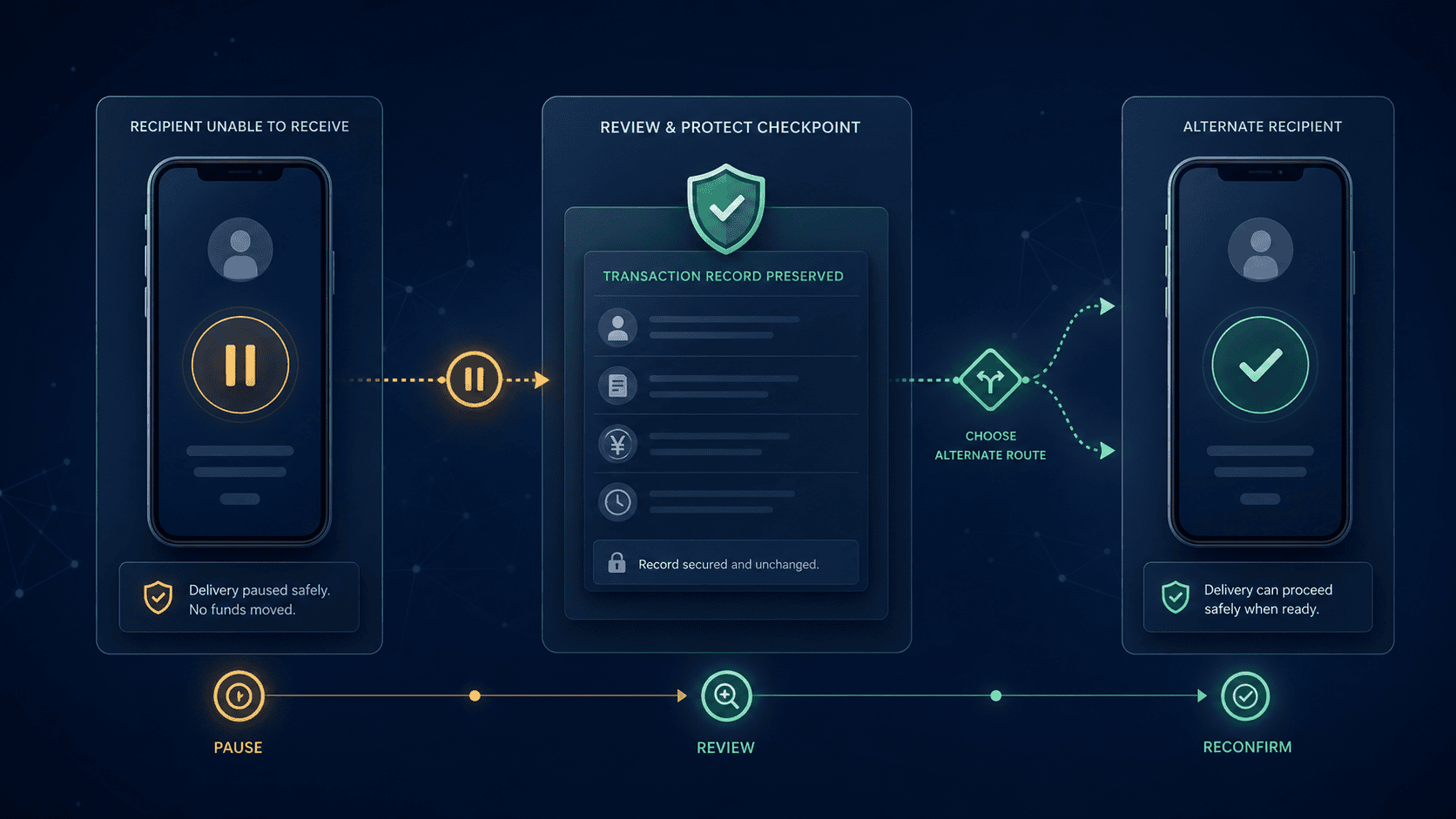
When a mobile recipient cannot receive RMB, the safest response is not to try random accounts. Stop, identify which stage failed, preserve the transaction record, and ask for the route to be assessed.
First locate the failure
“It did not work” can describe several different events. The recipient account may be unavailable during review; the displayed name may not match; a platform may reject or delay an instruction; the recipient may be checking the wrong account; or the payment may need reconciliation. Ask what evidence exists and avoid declaring success or failure from one screenshot.
Keep the blockchain event separate. A confirmed USDT transaction shows an on-chain transfer; it does not prove that an Alipay or WeChat Pay recipient received RMB.
If USDT has not been sent
- Pause the request.
- Confirm the recipient’s complete name and current account information.
- Ask whether the account is intended and suitable for the real payment purpose.
- Report any error or limitation accurately.
- Wait for the route, expected RMB, quote, wallet, and network to be reconfirmed together.
This is the easiest point to change course because no irreversible blockchain transfer has been approved. Compare alternatives through the recipient-route guide.
If USDT has already been sent
Do not send a second amount and do not promise the supplier an alternate recipient. Save the transaction hash, network, addresses, amount, quote, recipient details, and time. Contact the desk through the published website channel and describe the exact issue.
The correct next step depends on what happened. It may involve waiting for more information, reconciling the intended account, reviewing corrected details, or determining that the requested route cannot continue. Recovery, rerouting, or completion must not be assumed.
Why rapid recipient switching is risky
A sequence of unrelated QR codes or personal accounts makes it harder to determine who should receive the payment and why. It can also separate the beneficiary from the invoice or payment purpose. China’s rules for non-bank payment institutions emphasize real-name accounts, accurate payment instructions, transaction traceability, risk controls, and record preservation. Those principles support a cautious approach to recipient substitutions.
This article does not claim to describe every Alipay or WeChat Pay platform restriction. Account behavior and route availability can change, and the specific recipient must be checked at the time of the request.
A better conversation with the recipient
- Ask them to confirm which account they checked.
- Record the displayed account name without publishing it.
- Request the exact error wording rather than a paraphrase.
- Confirm whether they expected a personal or business-related payment.
- Ask whether the account or QR code changed after the quote.
- Keep invoice or order references available for reconciliation.
A clear response is more useful than repeated “try again” messages. If the name or account differs, follow the recipient-mismatch procedure.
Primary regulatory background
The People’s Bank of China publishes the Regulations on Supervision and Administration of Non-bank Payment Institutions, including provisions concerning real-name accounts, payment-instruction integrity, traceability, risk controls, and transaction records. This article applies those broad safety principles without claiming a specific platform decision.
Questions about unavailable recipients
Can I switch from WeChat Pay to Alipay?
Possibly, but never on your own. The recipient, route, rate, expected RMB, quote validity, wallet, and timing need reconfirmation.
Can the recipient use another person’s account?
Do not assume so. The new owner and their relationship to the payment require review.
Should I send a small test transfer?
Only if it forms part of an explicitly confirmed instruction. An unapproved test can create a second unmatched transaction.
Preserve the evidence and use the official contact page before changing any account or sending again.
When a recipient cannot receive RMB
First confirm whether the issue is an account limit, identity verification, unsupported recipient type, incorrect name, service outage, or a route-specific restriction. Do not repeatedly resend funds while the cause is unknown. Ask the recipient to check the official app or bank notice and provide the exact error or status message.
Keep the quote, recipient details, transaction hash, screenshots, and support reference together. If the route cannot be used, request a new confirmed route and amount before taking action. Any replacement route should be checked against the invoice, recipient identity, fees, and compliance requirements.