
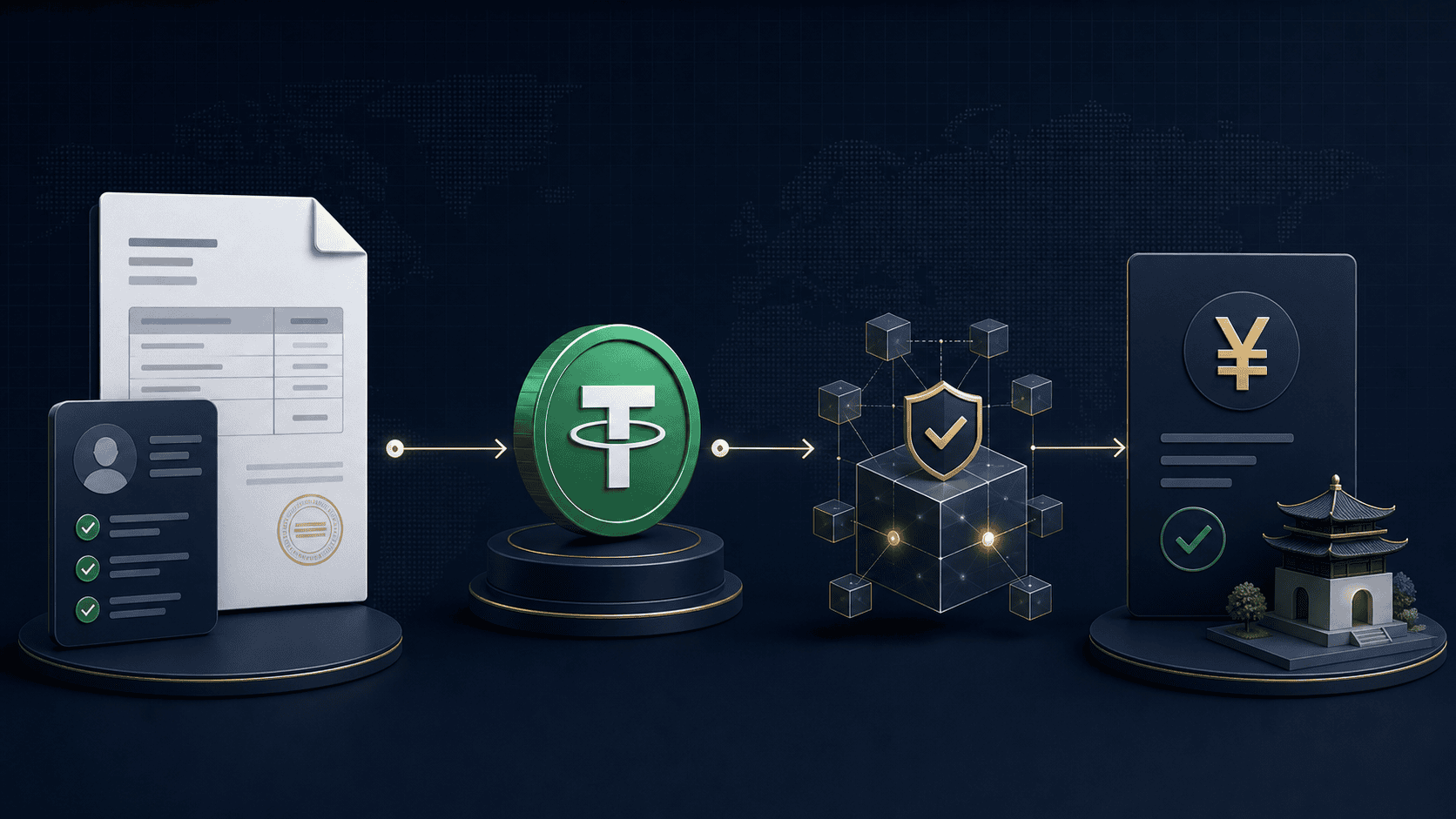
A supplier asking for RMB does not make the payment instruction complete. Before USDT moves, the buyer needs to connect the commercial reason for the payment with the correct Chinese recipient, an available RMB route, and one current transaction confirmation.
Begin with the commercial record
For a real supplier payment, keep the purchase order, invoice, contract, or written order summary that explains the goods or services. The names, amount, currency, order reference, and payment stage should agree. If the invoice is from one company but the requested recipient belongs to another person or business, ask the supplier to explain the relationship before requesting a final quote.
This is not paperwork for its own sake. A clean commercial record makes it easier to identify a substituted account, an altered invoice, or a recipient that does not fit the stated payment.
Ask one awkward question early
Who owns the account that will receive RMB? Buyers sometimes receive a bank account in one message, an Alipay QR code in another, and a different company name on the invoice. Do not combine those fragments into your own payment instruction. Ask the supplier’s responsible contact to provide one complete recipient record.
Then compare the proposed route using the Alipay, WeChat Pay, and Chinese bank TT guide. The most convenient route is not automatically suitable for the amount, recipient, purpose, or available review.
Information worth preparing before the quote
- Supplier or beneficiary name and relationship to the invoice.
- Invoice number, order reference, purpose, and RMB amount due.
- Requested route and complete recipient fields.
- The country from which the buyer is making the request.
- USDT amount available and networks supported by the sending wallet.
- The genuine deadline, including any production or shipment dependency.
- Relevant source-of-funds or identity context if requested.
Sharing an outline does not authorize a transfer. It gives the desk enough context to explain what else may be required. See the broader pre-payment information guide.
The final confirmation is a joined record
Before approving the withdrawal, compare the exact USDT amount, executable rate, expected RMB, current wallet, supported network, supplier recipient, route, validity window, and timing limitations. A correct invoice cannot repair a wrong blockchain network, and a correct wallet cannot repair an unreviewed beneficiary.
If the supplier changes the account after the quote, pause. Treat the change as new information and ask for the transaction to be reviewed again. The same applies when an employee asks the buyer to ignore the company account and pay a personal account instead.
Factory deposit scenario: where verification changes the outcome
Consider an importer preparing a production deposit. The factory issues an invoice in its company name, but a sales contact later sends a personal Alipay QR code and asks for immediate payment. The buyer also has an older Chinese bank account from a previous order.
The safe response is not to choose whichever route appears fastest. The buyer should ask the factory to confirm which recipient is authorized for this invoice, explain any relationship between the company and a personal recipient, and provide one current receiving record. The desk can then review the amount, purpose, recipient, route, network, and quote together.
If the factory confirms its company bank account and needs a bank record, Chinese bank TT may be considered. If an eligible mobile recipient is properly connected to the payment and suitable for the amount and purpose, Alipay or WeChat Pay may be considered. No route should be selected solely from a generic speed or fee claim.
Decision record for a deposit or balance
- Identify whether the payment is a deposit, balance, sample, tooling charge, logistics charge, or another obligation.
- Record the invoice or order reference and expected RMB amount.
- Confirm who owns the proposed account and why that recipient is connected to the supplier.
- Reconfirm changed details through a trusted supplier contact.
- Keep the final quote, wallet, network, TXID, recipient, and completion evidence with the order record.
Records after funds move
Keep the quote, transaction hash, network, addresses, token amount, timestamp, invoice, reviewed beneficiary, expected RMB, and available completion confirmation together. Give the supplier only the reconciliation information they need; do not post wallet or beneficiary screenshots publicly.
Bank of China’s published remittance guidance illustrates why accurate beneficiary and bank information matters in conventional transfers. Requirements differ by route and transaction, so use such material as background—not as a substitute for the current instruction.
Primary background source
For examples of the beneficiary and bank fields used in conventional remittance instructions, see Bank of China Singapore’s international remittance requirements. The current ExtentExchange transaction instruction remains controlling for a USDT-funded RMB request.
Questions buyers usually ask
Can I pay a supplier’s employee?
Do not assume so. Ask why the account differs from the contracting or invoicing party and wait for review.
Should I request the quote before receiving the invoice?
You can ask an indicative question, but the recipient and commercial context should be ready before executable terms are confirmed.
Does an on-chain success prove the invoice is paid?
No. It proves a blockchain event. The RMB-side recipient confirmation and the supplier’s reconciliation remain separate.
Use the official contact page with the amount, route, beneficiary, invoice context, and genuine deadline.