
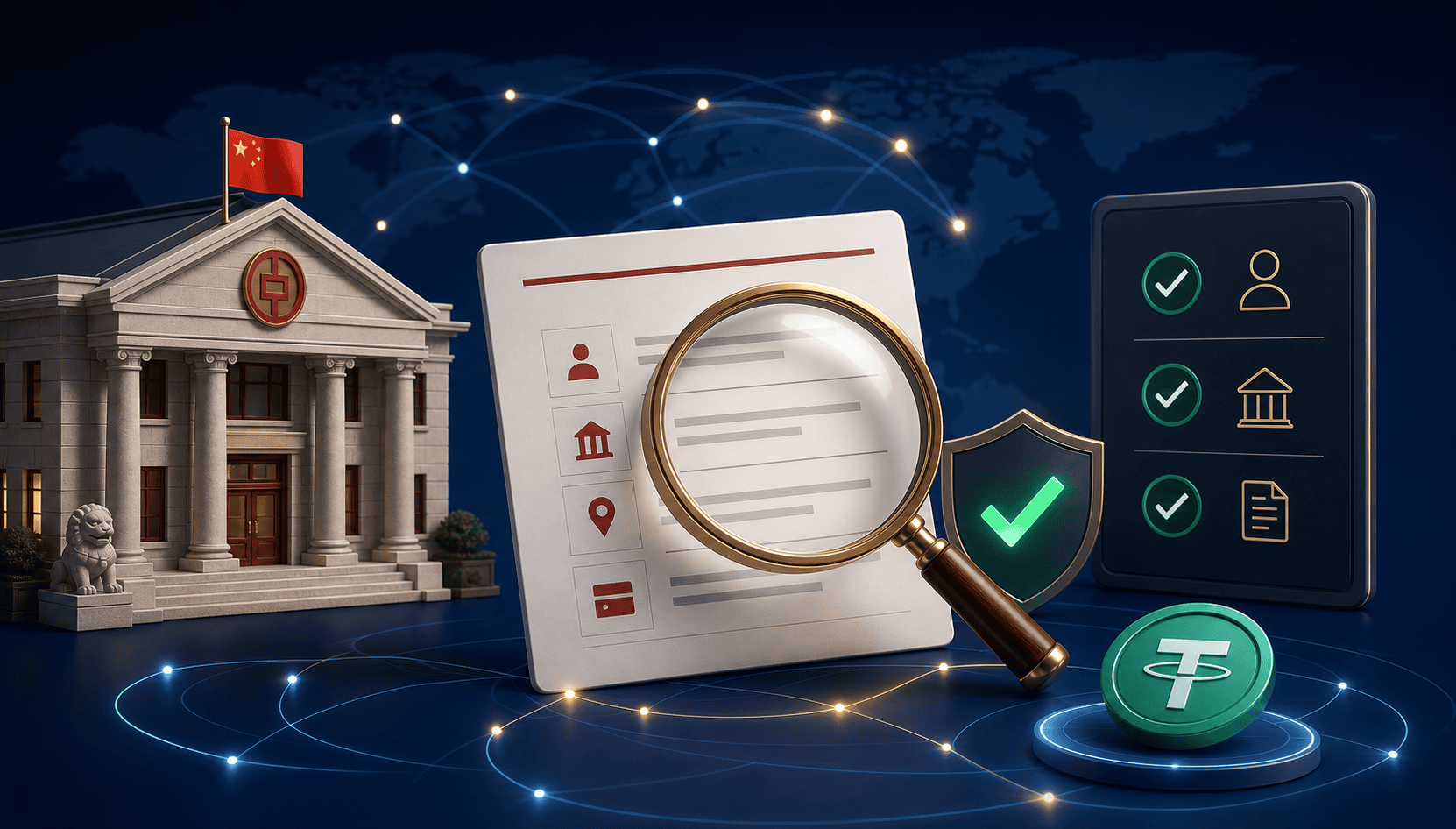
A Chinese bank TT request requires a complete beneficiary record as well as a confirmed USDT transfer. Before sending funds, check the account-holder name, bank and branch information requested by the desk, account number, payment purpose, exact quote, supported network, wallet, and expected RMB.
Build the beneficiary record first
Ask the recipient for the bank information in the format requested for the current transaction. The desk may require the full account-holder name, bank name, branch information, account number, location or routing details, payment purpose, and supporting context.
Copying bank information from an old invoice or earlier transfer can create a mismatch if the beneficiary has changed banks, branches, accounts, or legal details. Reconfirm it with the intended recipient.
Information checklist
- Full beneficiary or account-holder name.
- Chinese bank name and requested branch information.
- Account number in the requested format.
- Province, city, or other routing detail if requested.
- Required RMB amount.
- Accurate reason for the payment.
- Relevant invoice or supporting context if requested.
- USDT amount, supported network, and current wallet.
- Executable rate, expected RMB, validity, and timing estimate.
Share sensitive banking information only through the verified contact process and only to the extent requested.
Why exact matching matters
A small difference in a personal or business name can prevent clean reconciliation or suggest that the account is not the beneficiary reviewed for the request. Missing branch or routing information may also delay clarification.
Do not silently correct, translate, shorten, or substitute a beneficiary field. Present the information as supplied and ask the desk how it should be confirmed.
Connect the beneficiary to the commercial record
For a supplier or factory payment, the bank fields should agree with the underlying invoice, purchase order, contract, or written order summary. Compare the legal or registered beneficiary name, invoice issuer, amount, currency, payment stage, and stated purpose. A bank account can be technically complete while still being inconsistent with the transaction it is meant to settle.
Do not assume that a proforma invoice, commercial invoice, purchase order, contract, customs record, or identification document is universally required. Requirements differ by bank, jurisdiction, beneficiary, amount, and transaction. Prepare the records that genuinely exist and wait for the current request to identify what is needed.
Questions to resolve before approval
- Does the beneficiary name match the supplier or have a documented relationship to it?
- Does the RMB amount match the current invoice stage, such as deposit or balance?
- Is the payment purpose accurate and consistent with the supporting record?
- Were bank details confirmed through a trusted supplier contact rather than only a forwarded message?
- Has any account, branch, beneficiary, or invoice detail changed since the quote?
Bank of China publishes examples of beneficiary and remittance information used in conventional RMB remittance services, including beneficiary identity and bank fields. These examples provide background only; they do not define every ExtentExchange or receiving-bank requirement. See Bank of China UK’s RMB pre-settlement remittance information.
Confirm the quote as one complete record
The transaction-specific confirmation should connect the USDT amount and network to the intended bank-side RMB outcome. Verify:
- the exact amount of USDT to send;
- the supported network and complete wallet address;
- the final expected RMB;
- the approved beneficiary and bank details;
- the quote-validity window;
- the communicated processing estimate and its limitations.
The public rate page is planning information. Use the written quote for the actual request.
What can cause a delay, return, or refusal?
Potential causes include an incorrect account number, incomplete beneficiary name, unsupported recipient, unclear payment purpose, changed bank information, expired quote, wrong USDT network, blockchain confirmation issues, receiving-bank controls, maintenance, or information requested during review.
Not every problem has the same remedy. Some can be corrected before transfer; others may make the route unsuitable. Never send funds assuming the bank or desk can fix recipient details afterward.
Keep records for both sides
Retain the quote, beneficiary information used for approval, wallet, network, transaction hash, USDT amount, expected RMB, and available bank-side completion confirmation. For a commercial payment, also retain the underlying invoice or reconciliation reference where appropriate.
Records should be stored securely. Do not publish bank details or transaction proof as marketing material without authorization and careful redaction.
Questions about Chinese bank TT
Can RMB be sent to any Chinese bank account?
No. Beneficiary, account, amount, purpose, supporting information, and current route availability are reviewed for each request.
Is bank TT always intended for large amounts?
No universal amount rule should be inferred. Suitability depends on more than size and must be confirmed for the specific request.
What if the recipient changes the account after I receive a quote?
Pause and submit the new details for review. Do not transfer under the earlier confirmation.
Use the Chinese bank TT route page, review transaction requirements, and confirm the beneficiary with the desk.